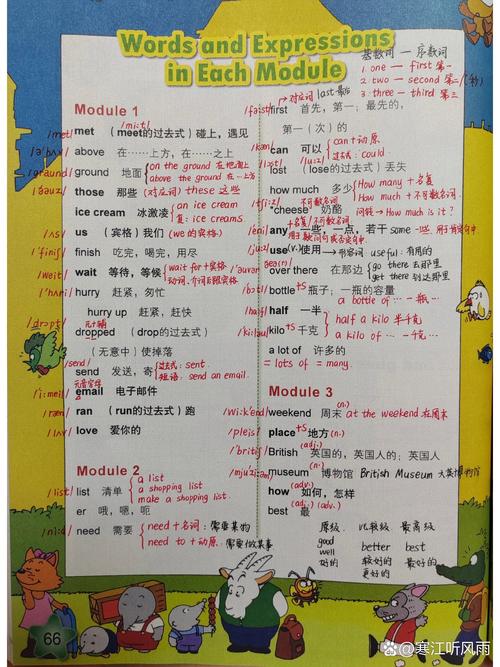
五年级是小学阶段英语学习的关键时期,学生开始从学习零散的词汇和句型,转向掌握更系统的语法知识和更连贯的语篇能力,外研版教材(通常指《英语》(新标准))围绕模块主题展开,内容贴近学生生活,注重培养听说读写四项技能。
(图片来源网络,侵删)
以下是五年级上册英语(外研版)的详细内容解析,包括模块主题、核心词汇、核心句型和语法点,希望能帮助您和孩子更好地学习。
整体结构与学习目标
- 教材结构:通常分为 10个模块,每个模块包含 2个单元。
- 单元分工:
- Unit 1:侧重于“输入”,通过对话或短文引出本模块的核心词汇和句型,重点是“听”和“说”。
- Unit 2:侧重于“输出”和巩固,通过更丰富的语篇(如故事、信件、介绍等)来复习和拓展所学知识,重点是“读”和“写”。
- 学习目标:
- 词汇:掌握约100-150个新单词和短语。
- 句型:熟练运用核心句型进行问答和交流。
- 语法:掌握现在进行时、情态动词
can/should、比较级等核心语法点。 - 技能:能听懂简短的指令和对话,能进行简单的日常交流,能读懂小故事,能写出简单的句子和短文。
各模块核心内容详解
以下是10个模块大致的主题和核心知识点(具体版本可能略有差异,但核心内容一致)。
Module 1: Getting to know each other (相互认识)
- Unit 1: He's a teacher.
- 核心词汇:
he, she, student, pupil, teacher, doctor, driver, farmer, nurse - 核心句型:
He's / She's a + 职业名词.(他是/她是一名……)What does he / she do?(他是做什么工作的?)
- 核心词汇:
- Unit 2: She's learning English.
- 核心词汇:
learning, English, very, much, speak, making, cake, playing, violin - 核心句型:
He's / She's + V-ing...(他/她正在做某事) —— 引出现在进行时— What is he / she doing? — He's / She's...(他/她在做什么?他/她在……)
- 核心词汇:
Module 2: My family and friends (我的家人和朋友)
- Unit 1: She's reading a book.
- 核心词汇:
reading, book, writing, letter, taking, picture, talking, friend - 核心句型:
主语 + be动词 + V-ing...(主语正在做某事) —— 现在进行时的肯定句— What are you doing? — I'm...(你在做什么?我在……)
- 核心词汇:
- Unit 2: I'm watching TV.
- 核心词汇:
watching, TV, washing, clothes, cleaning, room, helping, mum - 核心句型:
— Are you V-ing...? — Yes, I am. / No, I'm not.(你正在……吗?是的,我是。/不,我不是。) —— 现在进行时的否定句和一般疑问句
- 核心词汇:
Module 3: Activities (活动)
- Unit 1: She's listening to the radio.
- 核心词汇:
listening, radio, newspaper, look, at, him, talk, to - 核心句型:
He's / She's + V-ing...(他/她正在……)— What's he / she doing? — He's / She's...(他/她在做什么?)
- 核心词汇:
- Unit 2: I'm drawing a picture of a dragon.
- 核心词汇:
drawing, picture, dragon, boat, play, football, skipping, rope - 核心句型:
- 复习现在进行时,并引入
What about you?(你呢?) 进行互动。
- 复习现在进行时,并引入
- 核心词汇:
Module 4: In the playground (在操场上)
- Unit 1: Do you want some rice?
- 核心词汇:
want, some, rice, noodles, fish, milk, bread, egg - 核心句型:
Do you want some...?(你想要一些……吗?) ——want的一般疑问句Yes, please. / No, thank you.(好的,谢谢。/不,谢谢。)
- 核心词汇:
- Unit 2: How much is it?
- 核心词汇:
how much, one, yuan, two, three, four, five, six, seven, eight, nine, ten - 核心句型:
How much is it?(它多少钱?) —— 询问价格It's ... yuan.(它……元。)
- 核心词汇:
Module 5: There are only nineteen crayons. (这里只有十九支蜡笔)
- Unit 1: There are only nineteen crayons.
- 核心词汇:
there, are, only, nineteen, twenty, one, two, three...thirty - 核心句型:
There are + 数量 + 名词复数.(有……) ——There be句型 (复数)How many + 名词复数 + are there?(有多少……?)
- 核心词汇:
- Unit 2: There are forty.
- 核心词汇:
thirty, forty, fifty, sixty, seventy, eighty, ninety, hundred - 核心句型:
- 巩固
There be句型和How many的用法,学习数字31-100。
- 巩固
- 核心词汇:
Module 6: A week's holiday (一周的假期)
- Unit 1: What do you do on Mondays?
- 核心词汇:
Monday, Tuesday, Wednesday, Thursday, Friday, Saturday, Sunday, week, on - 核心句型:
What do you do on + 星期?(你在星期几做什么?)I + 动词原形 + ...(我……) —— 谈论日常活动
- 核心词汇:
- Unit 2: What do you do at the weekend?
- 核心词汇:
weekend, park, shop, cinema, visit, grandma, grandpa - 核心句型:
What do you do at the weekend?(你在周末做什么?)I + 动词原形 + ...(我……)
- 核心词汇:
Module 7: Teachers' Day (教师节)
- Unit 1: There is a horse in this photo.
- 核心词汇:
there, is, a, horse, sheep, vegetable, flower, eat, grass - 核心句型:
There is + a/an + 单数名词 + 地点.(有一个……在……) ——There be句型 (单数)— What's in the photo? — There's a...(照片里有什么?有一……)
- 核心词汇:
- Unit 2: There aren't any books in the box.
- 核心词汇:
aren't, any, book, desk, chair, bag - 核心句型:
There aren't any + 名词复数.(没有……) ——There be句型的否定式Are there any...?(有……吗?) ——There be句型的一般疑问句
- 核心词汇:
Module 8: At the shop (在商店)
- Unit 1: It's on your desk.
- 核心词汇:
in, on, under, behind, hat, coat, sweater, line, up, down - 核心句型:
Where is / are...?(……在哪里?) —— 询问方位It's / They're + 介词短语.(它在/它们在……)
- 核心词汇:
- Unit 2: Where do they live?
- 核心词汇:
they, live, fish, tree, hole, river, home - 核心句型:
Where do they live?(它们住在哪里?)They live in + 地点.(它们住在……)
- 核心词汇:
Module 9: Feelings (感受)
- Unit 1: Are you feeling sad?
- 核心词汇:
feeling, sad, angry, bored, happy, tired, worried - 核心句型:
Are you feeling + 形容词?(你感觉……吗?)Yes, I am. / No, I'm not.(是的,我。/不,我不。)
- 核心词汇:
- Unit 2: He's feeling bored.
- 核心词汇:
look, at, him, her, because, film, fast, food, run, after - 核心句型:
He's / She's feeling + 形容词.(他/她感觉……)Why? Because...(为什么?因为……)
- 核心词汇:
Module 10: Science and technology (科学与技术)
- Unit 1: These apples are very sweet.
- 核心词汇:
these, those, apple, banana, orange, sweet, sour, juice, yummy - 核心句型:
These / Those are + 形容词.(这些/那些是……的。)— What are these? — They're...(这些是什么?它们是……)
- 核心词汇:
- Unit 2: What's this?
- 核心词汇:
this, that, computer, bike, book, pen, desk, bag - 核心句型:
What's this / that?(这/那是什么?)It's a / an + 名词.(它是一个……。)
- 核心词汇:
核心语法点总结
-
现在进行时:
- 结构:
主语 + am / is / are + 动词-ing - 用法: 描述说话时正在发生的动作。
- 例句:
I am reading a book.She is listening to music.
- 结构:
-
There be句型: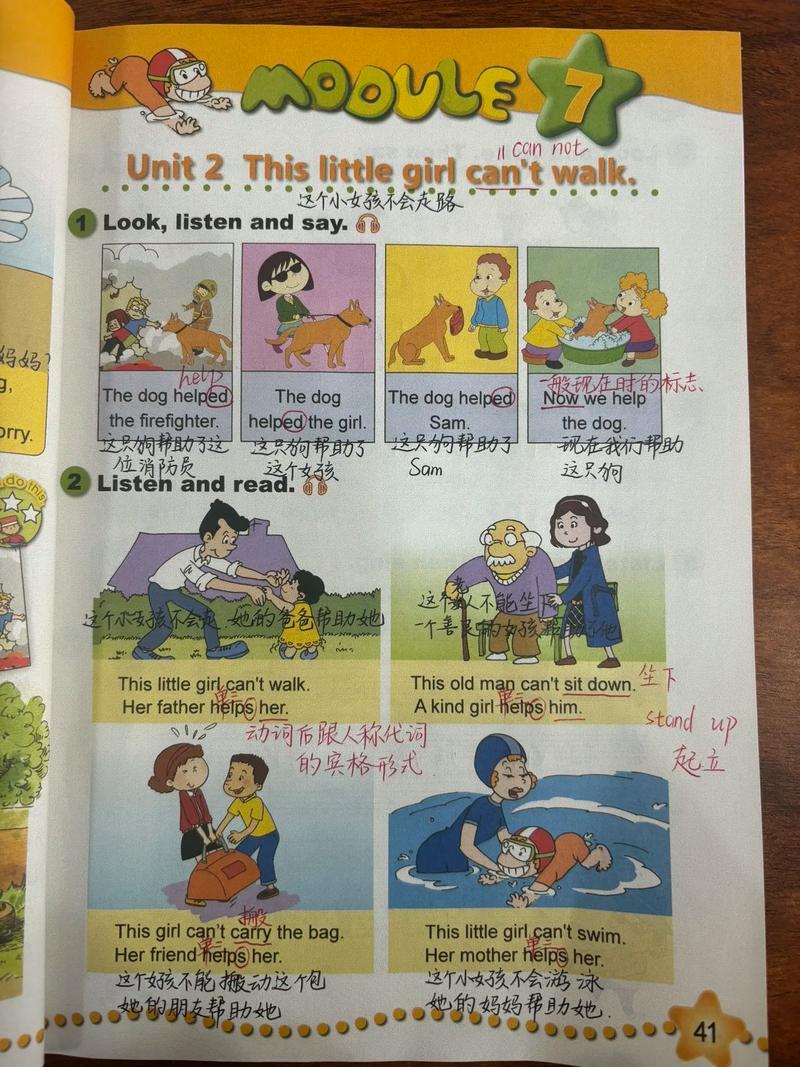 (图片来源网络,侵删)
- 含义: 表示“存在”,即“某地有某物”。
- 单数:
There is + a/an + 名词单数. - 复数:
There are + 名词复数. - 否定:
There isn't / There aren't... - 疑问:
Is there...? / Are there...?
-
Do引导的一般疑问句:- 结构:
Do / Does + 主语 + 动词原形 + ...? - 用法: 用于询问习惯性、经常性的动作或事实。
- 例句:
Do you like apples?Does he go to school by bus?
- 结构:
-
方位介词:
- 核心词:
in(在...里面),on(在...上面),under(在...下面),behind(在...后面)
- 核心词:
-
How much询问价格:- 结构:
How much is it?(用于单数物品)How much are they?(用于复数物品) - 回答:
It's ... yuan.They are ... yuan.
- 结构:
学习建议
- 词汇是基础:利用单词卡片、APP或图片,结合“听、说、读、写”多种方式记忆单词,不要孤立地背。
- 句型要活用:不要只背句子,要理解其结构,并尝试替换不同的单词进行造句,做到“举一反三”。
- 语法在语境中学:语法规则要通过课文和对话来理解,而不是死记硬背规则,多读课文,语感自然就来了。
- 听说读写并重:
- 听: 多听课本配套录音,模仿语音语调。
- 说: 大胆开口,和家人、同学用英语进行简单的对话。
- 读: 坚持每天阅读英语小故事或短文,培养语感。
- 写: 从写单词、写句子开始,逐步过渡到写小短文,描述自己的日常生活。
- 保持兴趣:可以通过看英文动画片、唱英文歌等方式,让英语学习变得更有趣。
希望这份详细的梳理能对您有所帮助!祝学习愉快!
(图片来源网络,侵删)