小学英语重点知识点总结
小学英语的核心目标是培养学生的英语语感、听说能力和学习兴趣,知识点主要围绕“听、说、读、写”四项基本技能展开。
(图片来源网络,侵删)
第一部分:核心词汇
词汇是语言的基石,小学阶段的词汇主要围绕学生的日常生活和兴趣点展开。
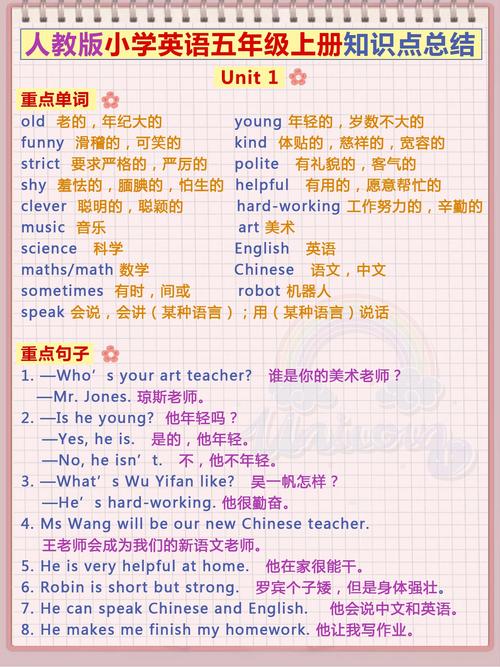
人物与家庭
- 家庭成员:
father (dad),mother (mom),parents,brother,sister,grandfather (grandpa),grandmother (grandma),family - 人物称谓:
boy,girl,baby,friend,Mr.,Miss,Mrs.,teacher,student
数字与时间
- 数字:
one到twelve(1-12),thirteen到nineteen(13-19),twenty到ninety-nine(20-99),hundred(百) - 时间:
time,o'clock,half past,quarter past/to,morning,afternoon,evening,night,Monday到Sunday,today,tomorrow,yesterday
颜色与形状
- 颜色:
red,yellow,blue,green,black,white,orange,purple,pink,brown,gray - 形状:
circle(圆形),square(正方形),triangle(三角形),rectangle(长方形),star(星形)
动物与植物
- 常见动物:
cat,dog,pig,duck,bird,fish,rabbit,monkey,panda,tiger,lion,bear,elephant,zebra - 植物:
tree,flower,grass,leaf(leaves),apple,banana,pear,orange
食物与饮料
- 主食:
rice,noodles,bread,egg,cake,hamburger,hot dog - 水果:
apple,banana,pear,orange,grape,watermelon,strawberry - 蔬菜:
carrot,potato,tomato,cucumber,broccoli - 饮料:
water,milk,juice,tea,Coke
学校与学习用品
- 场所:
school,classroom,library,playground - 人物:
teacher,student,classmate - 用品:
book,pen,pencil,ruler,eraser,bag,desk,chair,blackboard
身体部位
head,hair,eye,ear,nose,mouth,face,arm,hand,finger,leg,foot(feet),body
衣物
clothes,shirt,T-shirt,skirt,dress,pants,shorts,shoes,socks,hat,cap
天气与自然
- 天气:
weather,sunny,cloudy,rainy,windy,snowy,hot,cold - 自然景物:
sun,moon,star,sky,cloud,rain,snow,wind
交通与地点
- 交通工具:
bike(自行车),bus,car,taxi,train,plane,ship,boat - 地点:
home,room,zoo,park,farm,cinema,shop,hospital
第二部分:核心句型
句型是语言的骨架,掌握核心句型能让学生进行简单的交流和表达。
问候与告别
Hello! / Hi!(你好!)Good morning / afternoon / evening.(早上/下午/晚上好。)How are you?(你好吗?)I'm fine, thank you. And you?(我很好,谢谢,你呢?)I'm OK, thanks.(我不错,谢谢。)Goodbye! / Bye-bye! / See you later.(再见!)
介绍与询问
- 姓名:
What's your name?(你叫什么名字?)My name is... / I'm...(我叫...) - 年龄:
How old are you?(你多大了?)I'm ... years old.(我...岁了。) - 国籍:
Where are you from?(你来自哪里?)I'm from China.(我来自中国。) - 班级:
What class are you in?(你在哪个班?)I'm in Class One, Grade Five.(我在五年级一班。)
个人喜好
- 食物:
Do you like...?(你喜欢...吗?)Yes, I do. / No, I don't.(是的,我喜欢。/ 不,我不喜欢。) - 颜色:
What color is it?(它是什么颜色?)It's...(它是...)What's your favorite color?(你最喜欢的颜色是什么?)My favorite color is...(我最喜欢的颜色是...) - 动物/运动等:
What's your favorite animal?(你最喜欢的动物是什么?)My favorite animal is...(我最喜欢的动物是...)
拥有与所属
This is / That is...(这是/那是...)These are / Those are...(这些/那些是...)I have a...(我有一个...)It has...(它有...)Whose... is this?(这是谁的...?)It's mine / yours / his / hers.(是我的/你的/他的/她的。)
地点与方位
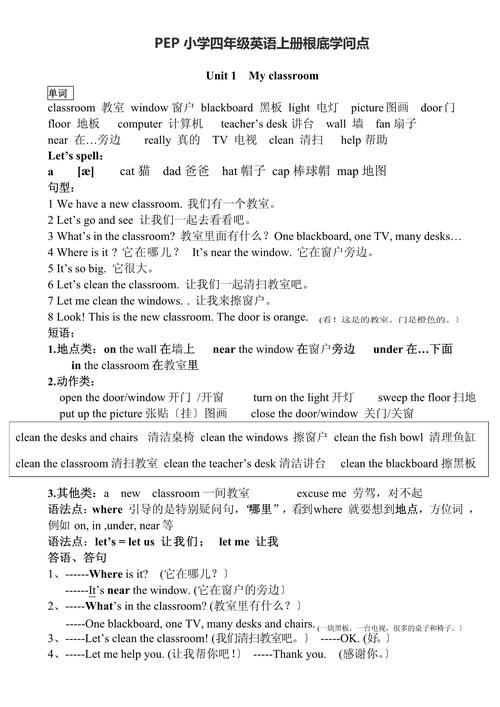
Where is...?(...在哪里?)It's in / on / under / near...(它在...里面/上面/下面/旁边。)Is it in...?(它在...里面吗?)Yes, it is. / No, it isn't.(是的,在。/ 不,不在。)
日常活动
What are you doing?(你在做什么?)I'm...(我正在...)What is he/she doing?(他/她在做什么?)He/She is...(他/她正在...)I can...(我会...)Can you...?(你会...吗?)Yes, I can. / No, I can't.(是的,我会。/ 不,我不会。)
询问能力
Can you...?(你会...吗?)Yes, I can. / No, I can't.(是的,我会。/ 不,我不会。)
描述外貌与特征
What does he/she look like?(他/她长什么样?)He/She is tall and thin.(他/她又高又瘦。)He/She has long hair.(他/她有长头发。)
第三部分:核心语法
语法是语言的规则,是保证表达正确的关键。
名词
- 可数名词: 有单复数之分。
- 规则变化:
book - books,cat - cats,bus - buses(以s, x, sh, ch结尾加es),baby - babies(以“辅音+y”变y为i加es) - 不规则变化:
man - men,woman - women,child - children,foot - feet,mouse - mice
- 规则变化:
- 不可数名词: 没有复数形式,不能用
a/an或数字直接修饰,如water,milk,rice,bread。- 量词:
a glass of water,a bottle of milk,a piece of bread。
- 量词:
代词
- 人称代词:
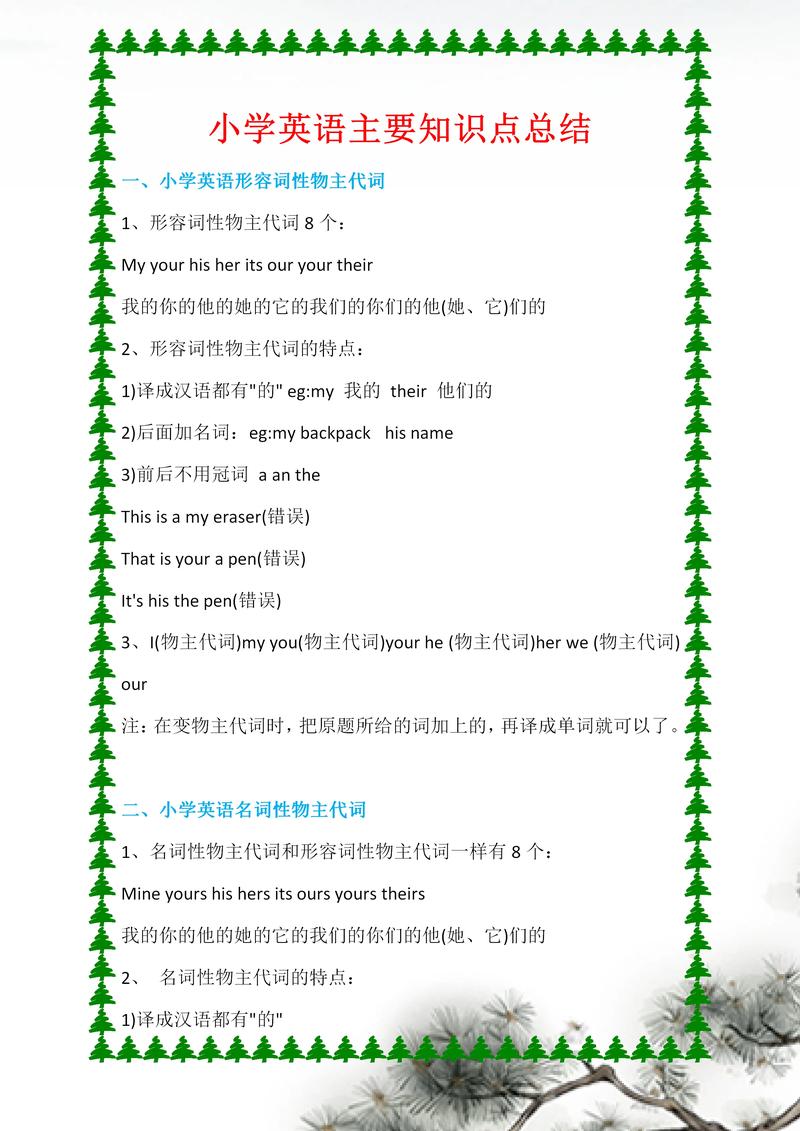
I (我),you (你/你们),he (他),she (她),it (它),we (我们),they (他们/她们/它们) - 物主代词: 表示“我的、你的、他的...”。
- 形容词性物主代词: 后面必须跟名词。
my book,your bag,his name - 名词性物主代词: 后面不跟名词,相当于“...的东西”。
This is mine.,That is yours.
- 形容词性物主代词: 后面必须跟名词。
冠词
- a/an: 用于单数可数名词前,表示“一个”。
a用在辅音音素开头的单词前:a book,a dogan用在元音音素开头的单词前:an apple,an egg
- the: 定冠词,特指某个或某些事物。
the book on the desk(桌上的那本书)
形容词
- 用来修饰名词,描述人或事物的特征。
big,small,long,short,tall,fat,thinnew,old,happy,sad,beautiful,nice
- 位置: 通常放在名词前面。
a big apple
动词
- be动词:
am,is,aream+I->I amis+he/she/it/单数名词->He/She/It isare+you/we/they/复数名词->You/They are
- 情态动词:
can(能,会)can+ 动词原形 ->I can swim.
- 实义动词: 表示具体动作的词,如
like,have,go,play,eat,drink。- 在第三人称单数(he/she/it)作主语时,动词要加
s或es。He likes apples.
- 在第三人称单数(he/she/it)作主语时,动词要加
介词
- 表示方位、时间等关系。
- 方位:
in(在...里面),on(在...上面),under(在...下面),near(在...旁边),behind(在...后面),in front of(在...前面) - 时间:
at(在具体时间点,如at 7 o'clock),on(在具体某一天,如on Monday),in(在月份、季节、年份,如in May,in summer,in 2025)
- 方位:
基数词与序数词
- 基数词: 表示数量。
one, two, three... - 序数词: 表示顺序,常用于日期。
first (1st),second (2nd),third (3rd),fourth (4th),fifth (5th),eighth (8th),ninth (9th),twelfth (12th)twenty-first (21st)
句子基本结构
- 陈述句: 主语 + 谓语 + 其他。
I am a student.He likes apples.
- 一般疑问句: 把 be动词/情态动词/助动词 提到句首,句末用问号。
Are you a student?Does he like apples?
- 特殊疑问句: 疑问词 (What, Where, When, Who, Why, How) + 一般疑问句。
What is your name?Where is my book?
第四部分:语音知识
语音是听说的基础,尤其要注重培养语感。
(图片来源网络,侵删)
字母发音
- 掌握26个字母的名称音和发音(即音素)。
- 特别注意容易混淆的发音,如
b/p,d/t,v/w,s/sh。
国际音标
- 元音:
/i:/, ,/e/, , , , ,/u:/, , , , ,/eɪ/,/aɪ/, , ,/aʊ/, ,/eə/, - 辅音:
/p/,/b/,/t/,/d/,/k/,/g/,/f/,/v/,/s/,/z/, , , , ,/h/,/tʃ/,/dʒ/,/tr/,/dr/,/ts/,/dz/,/m/,/n/, ,/l/,/r/,/j/,/w/
重音与语调
- 单词重音: 双音节或多音节单词通常有一个重读音节,用重音符号 标出,如
`teacher`,happy。 - 句子语调:
- 升调: 用于一般疑问句、表示客气或请求的句子。
Are youOK? - 降调: 用于陈述句、特殊疑问句、感叹句。
I amfine.What's yourname?
- 升调: 用于一般疑问句、表示客气或请求的句子。
第五部分:学习建议
- 兴趣是最好的老师: 通过英文儿歌、动画片、绘本等方式,让孩子在轻松愉快的氛围中接触英语。
- 听说领先,读写跟上: 小学阶段应优先培养听力和口语能力,多听、多说,敢于开口,在听说有一定基础后,再逐步引入读写。
- 在语境中学习: 不要孤立地背单词和句型,将单词和句子放到具体的情景、故事或对话中去理解和记忆。
- 创设语言环境: 在家里可以贴一些英文单词卡片,鼓励孩子用简单的英文表达自己的需求,如
I want water.This is my book. - 及时复习,巩固记忆: 遵循艾宾浩斯遗忘曲线,对新学的知识要经常复习,可以通过游戏、闪卡等方式进行。
- 鼓励为主,建立自信: 对于孩子在学习中出现的错误,要耐心纠正,多给予鼓励和表扬,保护他们的学习积极性和自信心。
- 将英语与生活联系: 引导孩子观察生活中的英文,如食品包装上的英文、路牌、商店名称等,让英语学习变得生动有趣。
希望这份总结能对您有所帮助!祝孩子们在英语学习的道路上快乐前行!
(图片来源网络,侵删)