小学五年级上册英语核心单词表 (PEP教材)
Unit 1 What's he like? (他/她长什么样?)
| 单词 | 词性 | 中文意思 | 例句 |
|---|---|---|---|
| old | adj. | 年老的;旧的 | My grandfather is very old. (我的爷爷年纪很大了。) |
| young | adj. | 年轻的 | She is a young teacher. (她是一位年轻的老师。) |
| funny | adj. | 有趣的;滑稽的 | Our English teacher is very funny. (我们的英语老师非常有趣。) |
| kind | adj. | 和蔼的;友善的 | The panda is very kind. (这只熊猫非常友善。) |
| strict | adj. | 严格的 | Our math teacher is strict. (我们的数学老师很严格。) |
| polite | adj. | 有礼貌的 | He is a polite boy. (他是一个有礼貌的男孩。) |
| hard-working | adj. | 工作努力的;勤奋的 | She is a hard-working student. (她是一位勤奋的学生。) |
| helpful | adj. | 有帮助的;乐于助人的 | My friend is very helpful. (我的朋友非常乐于助人。) |
| clever | adj. | 聪明的 | He is a clever student. (他是个聪明的学生。) |
| shy | adj. | 害羞的 | The girl is very shy. (那个女孩很害羞。) |
| know | v. | 了解;认识 | I know your new teacher. (我认识你的新老师。) |
| our | pron. | 我们的 | This is our classroom. (这是我们的教室。) |
| Ms | n. | 女士 (用于婚姻状况不明的女性) | This is Ms Wang. (这是王女士。) |
| will | v. aux. | 将要;会 | He will be our new teacher. (他将成为我们的新老师。) |
| sometimes | adv. | 有时候 | I go to school by bus sometimes. (我有时候坐公交车去上学。) |
Unit 2 My week (我的星期)
| 单词 | 词性 | 中文意思 | 例句 |
|---|---|---|---|
| Monday | n. | 星期一 | We have English on Monday. (我们星期一有英语课。) |
| Tuesday | n. | 星期二 | I like Tuesday. (我喜欢星期二。) |
| Wednesday | n. | 星期三 | What do you do on Wednesday? (你星期三做什么?) |
| Thursday | n. | 星期四 | It's Thursday today. (今天是星期四。) |
| Friday | n. | 星期五 | I play football on Friday. (我星期五踢足球。) |
| Saturday | n. | 星期六 | I often read books on Saturday. (我星期六经常看书。) |
| Sunday | n. | 星期日 | I go shopping with my mom on Sunday. (我星期日和妈妈去购物。) |
| weekend | n. | 周末 | What do you do on the weekend? (你周末做什么?) |
| wash | v. | 洗;洗涤 | I wash my clothes on Sunday. (我星期日洗我的衣服。) |
| wash my clothes | 洗我的衣服 | ||
| do homework | 做作业 | I do my homework every day. (我每天做作业。) | |
| watch TV | 看电视 | He watches TV in the evening. (他晚上看电视。) | |
| play football | 踢足球 | They like to play football. (他们喜欢踢足球。) | |
| read books | 看书 | She reads books on the weekend. (她周末看书。) | |
| on the weekend | 在周末 | I play sports on the weekend. (我周末做运动。) |
Unit 3 What would you like? (你想要什么?)
| 单词 | 词性 | 中文意思 | 例句 |
|---|---|---|---|
| sandwich | n. | 三明治 | I'd like a sandwich, please. (我想要一个三明治。) |
| salad | n. | 沙拉 | I like vegetable salad. (我喜欢蔬菜沙拉。) |
| hamburger | n. | 汉堡包 | He eats a hamburger for lunch. (他午餐吃一个汉堡包。) |
| ice cream | n. | 冰淇淋 | Children love ice cream. (孩子们喜欢冰淇淋。) |
| tea | n. | 茶 | Would you like some tea? (你想要些茶吗?) |
| fresh | adj. | 新鲜的 | I like fresh vegetables. (我喜欢新鲜的蔬菜。) |
| healthy | adj. | 健康的 | Fruit is healthy food. (水果是健康的食物。) |
| delicious | adj. | 美味的 | The cake is delicious. (这个蛋糕很好吃。) |
| hot | adj. | 辣的;热的 | I like hot food. (我喜欢辣的食物。) |
| sweet | adj. | 甜的 | Candy is very sweet. (糖果很甜。) |
| drink | v. / n. | 喝;饮料 | I'd like to drink some water. (我想喝点水。) |
| thirsty | adj. | 口渴的 | I'm thirsty. Can I have some water? (我口渴了,能给我点水吗?) |
| favourite | adj. | 最喜欢的 | My favourite food is noodles. (我最喜欢的食物是面条。) |
| food | n. | 食物 | I like Chinese food. (我喜欢中国菜。) |
| onion | n. | 洋葱 | I don't like onions. (我不喜欢洋葱。) |
Unit 4 What can you do? (你会做什么?)
| 单词 | 词性 | 中文意思 | 例句 |
|---|---|---|---|
| sing English songs | 唱英文歌 | She can sing English songs. (她会唱英文歌。) | |
| do kung fu | 会武术;练功夫 | He can do kung fu. (他会武术。) | |
| dance | v. / n. | 跳舞 | I can dance. (我会跳舞。) |
| draw cartoons | 画卡通画 | The boy can draw cartoons. (这个男孩会画卡通画。) | |
| play the piano | 弹钢琴 | My sister can play the piano. (我的姐姐会弹钢琴。) | |
| swim | v. / n. | 游泳 | I can swim. (我会游泳。) |
| speak English | 说英语 | He can speak English well. (他英语说得很好。) | |
| cook | v. / n. | 烹饪;做饭 | My mother can cook. (我妈妈会做饭。) |
| play basketball | 打篮球 | They can play basketball. (他们会打篮球。) | |
| wash the clothes | 洗衣服 | I can wash the clothes. (我会洗衣服。) | |
| do some kung fu | 会一些功夫 | What can you do? I can do some kung fu. (你会做什么?我会一些功夫。) | |
| any | adj. | 一些;任何的 (用于疑问句和否定句) | Can he play football? - No, he can't play any sport. (他会踢足球吗?- 不,他不会任何运动。) |
| problem | n. | 问题;难题 | I have a problem. (我遇到了一个问题。) |
| no problem | 没问题 | - Can you help me? - No problem! (- 你能帮我吗?- 没问题!) |
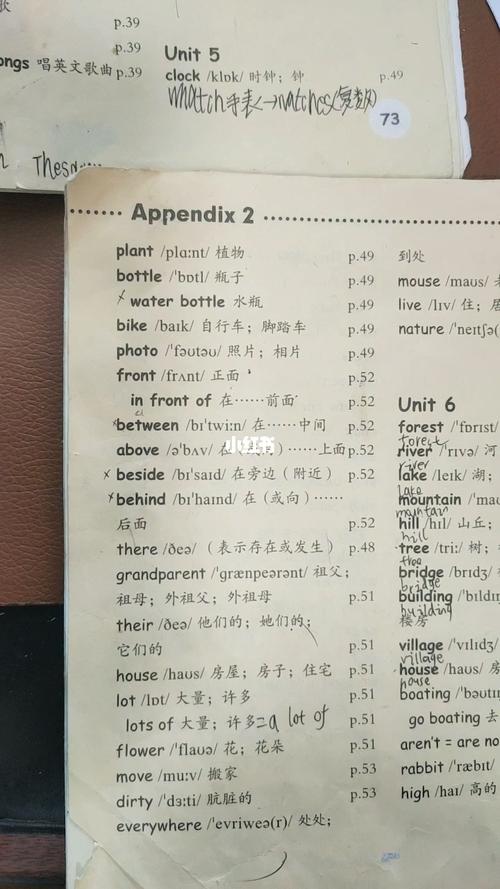
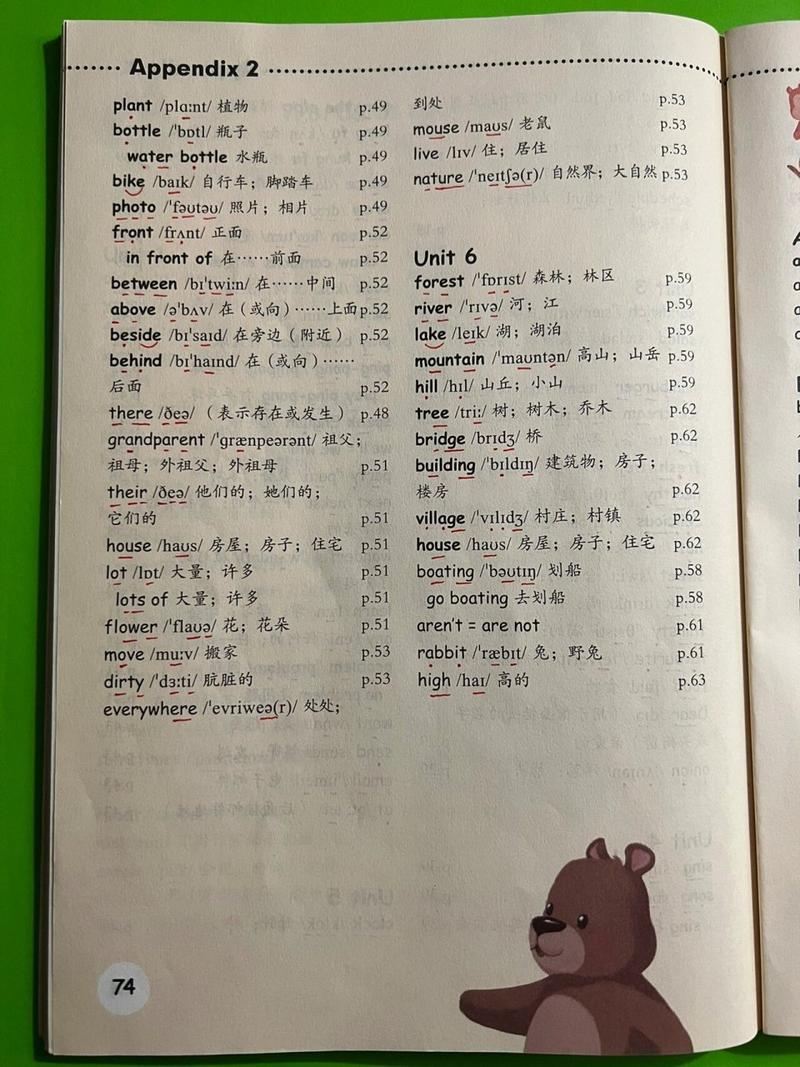
Unit 5 There is a big bed. (这里有一张大床。)
| 单词 | 词性 | 中文意思 | 例句 |
|---|---|---|---|
| there is | 有 (单数) | There is a clock on the wall. (墙上有一个时钟。) | |
| there are | 有 (复数) | There are many books in the library. (图书馆里有很多书。) | |
| clock | n. | 时钟 | There is a clock in my room. (我房间里有一个时钟。) |
| photo | n. | 照片 | Look at my photo. (看我的照片。) |
| wall | n. | 墙 | There is a picture on the wall. (墙上有一幅画。) |
| bed | n. | 床 | I have a new bed. (我有一张新床。) |
| lamp | n. | 台灯 | There is a lamp on the desk. (桌上有一盏台灯。) |
| live | v. | 居住 | I live in a small town. (我住在一个小镇上。) |
| room | n. | 房间 | This is my bedroom. (这是我的卧室。) |
| in front of | 在...前面 | The tree is in front of the house. (树在房子的前面。) | |
| beside | 在...旁边 | The ball is beside the door. (球在门旁边。) | |
| between | 在...之间 | The cat is between two dogs. (猫在两只狗之间。) | |
| behind | 在...后面 | The boy is hiding behind the tree. (那个男孩正躲在树后面。) | |
| above | 在...上面 | The lamp is above the table. (灯在桌子上面。) | |
| many | adj. | 许多 | There are many stars in the sky. (天空中有很多星星。) |
Unit 6 In a nature park. (在自然公园里。)
| 单词 | 词性 | 中文意思 | 例句 |
|---|---|---|---|
| forest | n. | 森林 | There is a forest in the park. (公园里有一片森林。) |
| river | n. | 河流 | There is a long river. (有一条长长的河。) |
| lake | n. | 湖泊 | The water in the lake is clean. (湖水很清澈。) |
| mountain | n. | 山;高山 | I want to climb the mountain. (我想去爬山。) |
| hill | n. | 小山 | There are many hills on the farm. (农场里有很多小山。) |
| tree | n. | 树 | There are many trees in the forest. (森林里有很多树。) |
| bridge | n. | 桥 | There is a bridge over the river. (河上有一座桥。) |
| building | n. | 建筑物 | There is a tall building in the city. (城里有一座高大的建筑物。) |
| house | n. | 房子 | This is my house. (这是我的房子。) |
| boating | n. | 划船 | We like boating on the lake. (我们喜欢在湖上划船。) |
| go boating | 去划船 | Let's go boating. (我们去划船吧。) | |
| picnic | n. / v. | 野餐 | They are having a picnic. (他们正在野餐。) |
| go for a picnic | 去野餐 | We go for a picnic on Sunday. (我们星期日去野餐。) | |
| nature park | 自然公园 | Is there a nature park in your city? (你们城市有自然公园吗?) | |
| gazebo | n. | 凉亭 | There is a gazebo in the park. (公园里有一个凉亭。) |
学习建议
- 分类记忆:将单词按主题(如人物、食物、活动、地点)分类,有助于建立联系。
- 结合句子:不要孤立地背单词,一定要结合例句或自己造句来理解和记忆。
- 多种感官:读出来(听觉)、写下来(视觉)、甚至可以画出来(视觉),调动多种感官参与记忆。
- 定期复习:利用艾宾浩斯遗忘曲线,制定复习计划,如当天、第二天、一周后复习,效果会更好。
- 趣味学习:可以通过看英文动画片、唱英文儿歌、玩单词卡片等方式增加学习的趣味性。
希望这份单词表能对您和您的孩子有所帮助!
(图片来源网络,侵删)
(图片来源网络,侵删)